
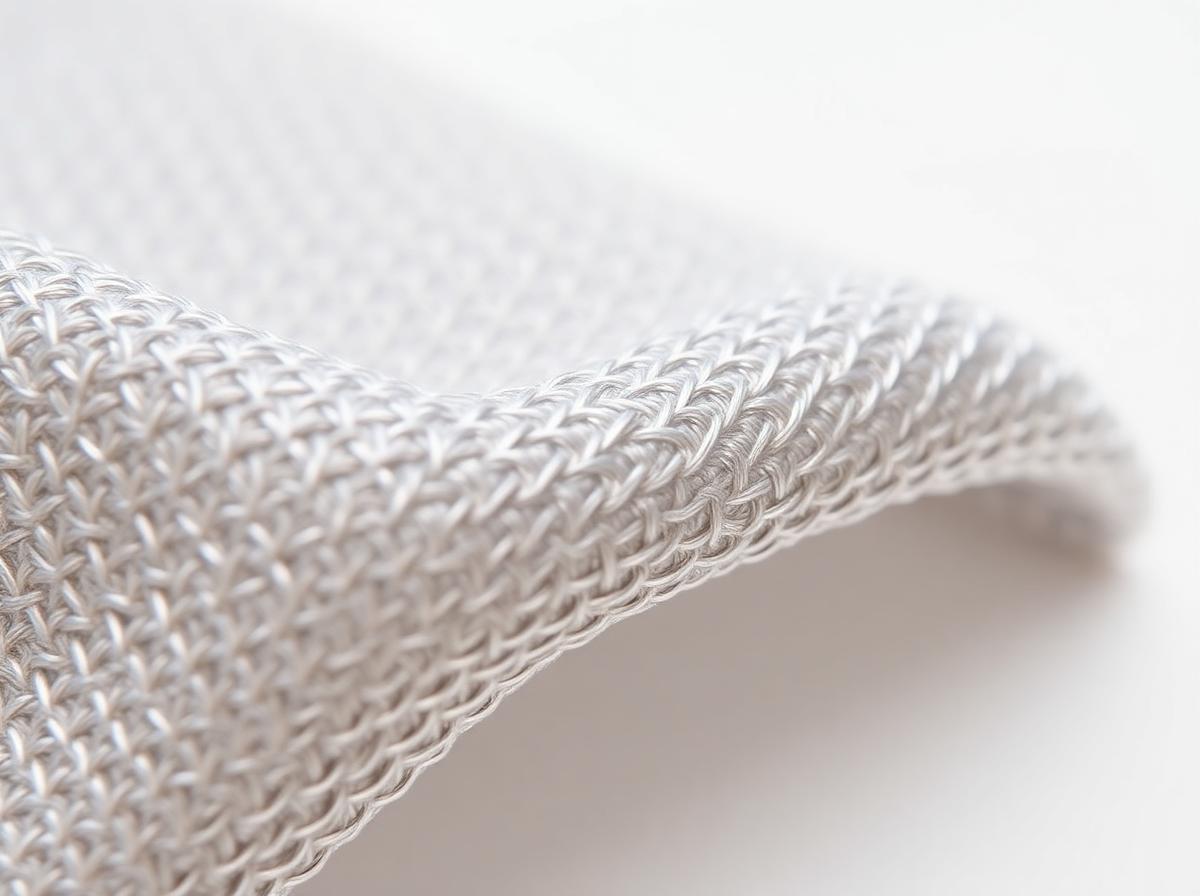
Single jersey / Interlock double-knit
Knitted Nickel Mesh
The standard PTL between bipolar plate and electrode in alkaline stacks. Single jersey (660-850 g/m², 90-98% porosity) for small-area stacks under 10 bar clamping — elastic enough to follow plate surface irregularities. Interlock (850-1,150 g/m², 85-92% porosity) for stacks over 0.8 m² where crush resistance matters. In 2019, a German field trial returned six stacks with PTL compression-set failure — single jersey had work-hardened after 5 years of thermal cycling, losing 40% thickness. We switched that customer to interlock. No failures since. Wire is always Ni201 — the knit has ~12,000 contact points per m², each a potential corrosion site with standard Ni200. Every roll ships with compression-recovery data at 5/10/15 bar, EN 10204 3.1 cert, ISO 9044 and ASTM B456.
Technical specifications
Rev. 2026-Q3 - compression recovery data available on request
| Alloy grades | Ni200 (UNS N02200), Ni201 (UNS N02201), N6 (Chinese GB) |
|---|---|
| Knit structure | Single jersey (single-bed) / Interlock (double-bed) |
| Wire diameter | 0.16 - 0.19 mm |
| Packing density | 660 - 1150 g/m² (customizable to target compression) |
| Porosity | 85 - 98 % volumetric (tunable via wire diameter and knit tension) |
| Corrugation depth | Up to 8 mm (enhances electrolyte mixing) |
| Compression recovery | Elastic spring-back; detailed recovery data on request |
| Roll width | Standard 1000; max 2700; custom slitting available mm |
| Nickel purity | Min 99.5% (Ni200/N6), min 99.0% (Ni201 low-carbon) |
| Applicable standards | ASTM B456, ISO 9044, ISO 4783 |
Related products
Need compression recovery data?
Compression set and elastic recovery curves for single jersey and interlock knit structures under 5-15 bar clamping pressure are available in our detailed technical report. Contact our applications team with your target compression force and active area for a customized PTL recommendation.
What is Knitted Nickel Mesh?
Knitted nickel mesh is an elastically compressible pure-nickel textile used as the porous transport layer (PTL) between the bipolar plate and the electrode in alkaline electrolyzer stacks, and as the cathode current collector in chlor-alkali membrane cells. Its three-dimensional loop structure acts as a spring under 5-15 bar stack clamping force: single jersey knit (660-850 g/m², 90-98% porosity) suits small-area stacks, while interlock double-knit (850-1,150 g/m², 85-92% porosity) resists crush in stacks above 0.8 m². Wire is always Ni201, supporting 60,000+ hour stack lifetimes.
Key facts
Packing density
660-1,150 g/m², customizable to target compression
Porosity
85-98% volumetric
Knit structures
Single jersey / interlock double-knit
Roll width
Standard 1,000 mm, max 2,700 mm, custom slitting
Related products & resources
Selection guide
The table below compares the options most often quoted for knitted nickel mesh enquiries.
| Knit structure | Typical specification | Best for |
|---|---|---|
| Single jersey | 660-850 g/m², 90-98% porosity, 0.16-0.19 mm Ni201 wire | Small-area stacks under 10 bar clamping |
| Interlock (double-knit) | 850-1,150 g/m², 85-92% porosity, 0.16-0.19 mm Ni201 wire | Stacks above 0.8 m² where crush resistance matters |
How to request a quote
- Step 1
Send your specification — product family, grade (Ni200/Ni201/N6), mesh count or packing density, wire diameter, quantity and certification standard.
- Step 2
Our applications team reviews the requirement and replies within one business day — within 24 hours on working days — with availability, lead time and pricing.
- Step 3
Confirm the proforma invoice; a sample Mill Test Certificate (EN 10204 3.1) is included with the quote, and a free 100×100 mm sample is available for standard mesh specifications.
- Step 4
Production, inspection and shipment proceed with the full documentation package — 100% of shipments include the lot-specific MTC.
Certification & traceability
Manufacturing is ISO 9001:2015 certified, and 100% of shipments include an EN 10204 3.1 Mill Test Certificate — OES chemistry, laser micrometer wire trace, optical mesh count and ASTM E8 tensile results — with a traceable heat number on every roll. Technical enquiries receive a substantive reply from a named materials engineer within one business day (within 24 hours on working days), and a sample MTC is included with every quote so your quality team can verify the documentation format up front.
Standards & references
ASTM International · International Organization for Standardization
Page last updated: 2026-09-28
Frequently Asked Questions (FAQ)
What knitted nickel mesh specification works as a porous transport layer (PTL)?
Single jersey at 660-850 g/m² with 90-98% porosity suits small-area stacks under 10 bar clamping. For stacks above 0.8 m², specify interlock at 850-1,150 g/m² with 85-92% porosity for crush resistance. Wire is always Ni201, 0.16-0.19 mm diameter.
Woven or knitted nickel mesh for my electrolyzer - which one?
Use woven mesh where a rigid, uniform-aperture substrate is needed, such as catalyst coating support. Use knitted mesh as the compressible PTL between bipolar plate and electrode: its 3D loop structure acts as an elastic spring under 5-15 bar clamping force and recovers when released.
How do you prevent compression-set failure in PTL mesh?
Single jersey can work-harden after years of thermal cycling - in one 2019 field trial it lost 40% thickness after 5 years. We switched that customer to interlock knit and there have been no failures since. Compression-recovery data at 5/10/15 bar is available with the technical report.
Why is Ni201 mandatory for knitted PTL mesh?
The knit structure has roughly 12,000 wire contact points per m², each a potential corrosion site. Ni200's carbon content (0.15% max) forms grain-boundary carbides that hot KOH attacks; Ni201 (0.02% C max) removes that failure path and supports 60,000+ hour stack lifetimes.