
About RAS
We make the nickel mesh that makes the reaction.
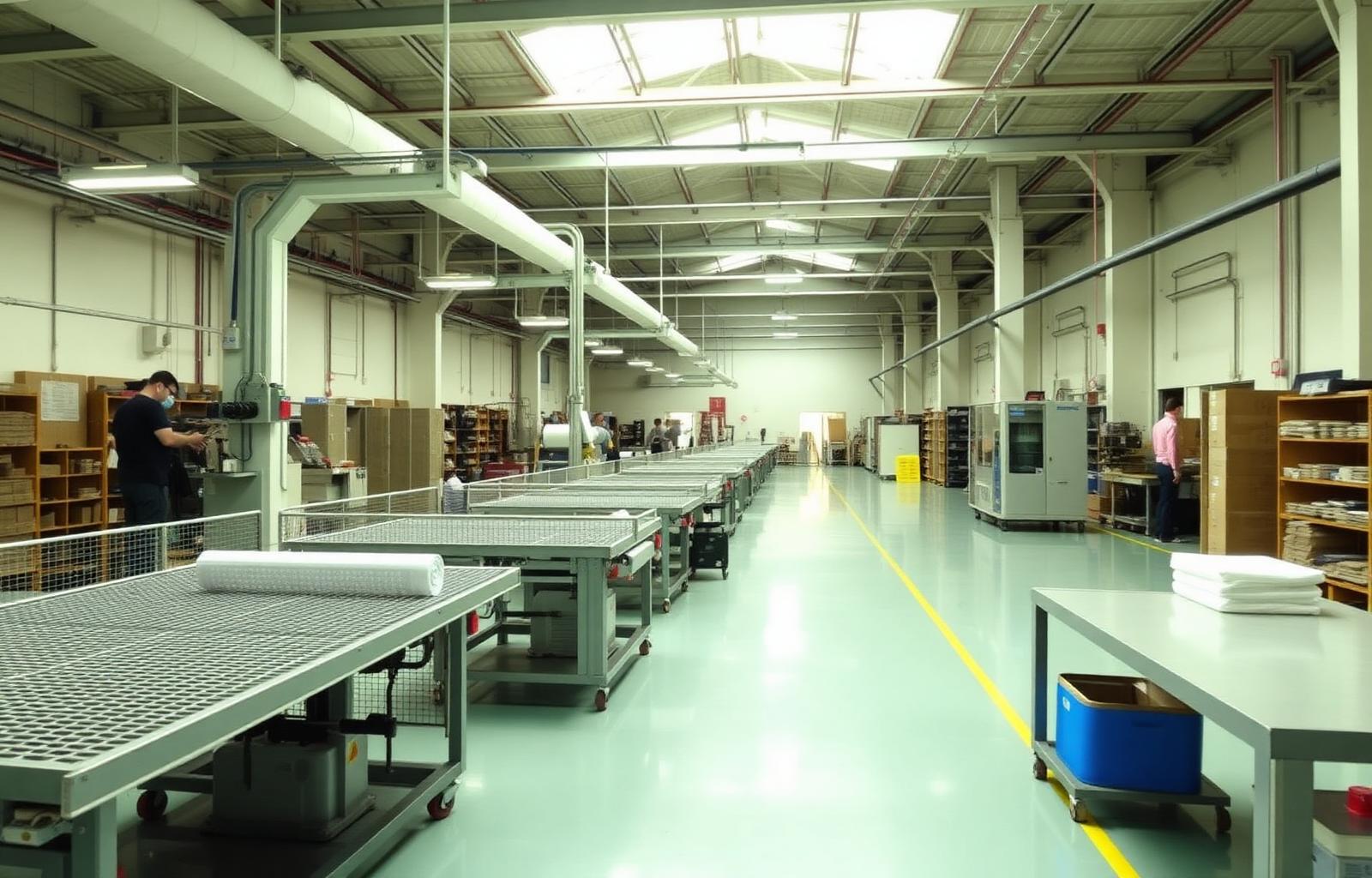
Hydromesh is the nickel mesh and wire brand of RAS Thermal Co., Ltd., our parent company for thermocouple alloy conductors. We make nickel mesh. That's all we do — no copper, no steel, no titanium. Since 2011. 18 rapier looms, 6 knitting machines, 14 wire-drawing lines. 12,000 m². Located inside China's wire mesh cluster where 70% of the world's industrial mesh is produced — suppliers 40km away, die shop across the street. 42 countries. 200+ customer accounts. Our largest customer — a top-3 global AWE manufacturer — has accepted 147 consecutive lots without rejection. That's their QA dashboard, not our marketing copy. ISO 9001:2015 since 2014. ASTM B456, ISO 9044, ASTM B162. EN 10204 3.1 certs on every shipment: OES chemistry, laser micrometer trace, optical mesh count, ASTM E8 tensile. Missing data point? Shipment stays on the dock. We learned that in 2016 — a missing elongation value held up a German clearance for six days. Hasn't happened since.
2,400 mm
Max woven mesh roll width
plus/minus 0.003 mm
Wire diameter tolerance
42
Countries supplied
ISO 9001:2015
Certified manufacturing
The philosophy
A cell is a chain of tolerances. You own the membrane, the catalyst, the bipolar plate design. We own the two links closest to the reaction surface: substrate geometry and metal purity. Screw up either one and the rest of your engineering doesn't matter. A 0.01mm deviation in wire diameter shifts open area by 2–3 percentage points — enough to move cell voltage by 50mV. Across a 200-cell stack, that's 10 volts of unnecessary overpotential. We've measured this. We built a test jig in 2018 that runs accelerated aging on mesh samples under actual KOH conditions, specifically to correlate wire tolerance with long-term voltage drift. Get the substrate right, and the catalyst, membrane, and balance of plant do the rest.
The commitment
Every shipment includes an EN 10204 3.1 Mill Test Certificate with chemical composition by OES, mesh count by optical inspection, wire diameter by laser micrometer, and tensile properties by ASTM E8. If a batch does not perform to specification — for any reason — we replace it, freight paid. Our reputation is built on electrolyzer stacks that run 60,000+ hours without a substrate-related failure.
Three product lines, one material
Woven Nickel Mesh
30-60 mesh, 0.19-0.30 mm wire, plain and twill weave. Ni200, Ni201, N6 grades. Catalyst support substrate for alkaline electrolyzer electrodes.
Knitted Nickel Mesh
660-1150 g/m2, 85-98% porosity, single jersey and interlock knit. Porous transport layer with elastic spring-back under stack compression.
Nickel Wire
0.025-8.0 mm diameter, plus/minus 0.003 mm tolerance. Ni200 and Ni201 grades, annealed temper. Current collector lead wire for electrode assemblies.
Get in touch
Working on a hydrogen project?
Tell us your cell parameters. We return a matched weave recommendation within one business day.
What is RAS Hydromesh?
RAS Thermal Co., Ltd. is a precision nickel mesh and wire manufacturer whose Hydromesh brand supplies woven mesh, knitted mesh and nickel wire — nothing else, no copper, no steel, no titanium — to alkaline electrolyzer, chlor-alkali and fuel cell OEMs. Operating since 2011 with 18 rapier looms, 6 knitting machines and 14 wire-drawing lines across 12,000 m² inside China's wire mesh manufacturing cluster, the company is ISO 9001:2015 certified since 2014 and supplies 200+ customers across 42 countries, with an EN 10204 3.1 Mill Test Certificate on 100% of shipments.
Key facts
Focused experience
15+ years making nickel mesh only
Customer base
200+ customers across 42 countries
Acceptance record
147 consecutive lots accepted by a top-3 global AWE OEM
Certified since 2014
ISO 9001:2015 · 100% EN 10204 3.1 MTC coverage
Related products & resources
How to request a quote
- Step 1
Send your specification — product family, grade (Ni200/Ni201/N6), mesh count or packing density, wire diameter, quantity and certification standard.
- Step 2
Our applications team reviews the requirement and replies within one business day — within 24 hours on working days — with availability, lead time and pricing.
- Step 3
Confirm the proforma invoice; a sample Mill Test Certificate (EN 10204 3.1) is included with the quote, and a free 100×100 mm sample is available for standard mesh specifications.
- Step 4
Production, inspection and shipment proceed with the full documentation package — 100% of shipments include the lot-specific MTC.
Certification & traceability
Manufacturing is ISO 9001:2015 certified, and 100% of shipments include an EN 10204 3.1 Mill Test Certificate — OES chemistry, laser micrometer wire trace, optical mesh count and ASTM E8 tensile results — with a traceable heat number on every roll. Technical enquiries receive a substantive reply from a named materials engineer within one business day (within 24 hours on working days), and a sample MTC is included with every quote so your quality team can verify the documentation format up front.
Frequently Asked Questions (FAQ)
Who is RAS Hydromesh?
RAS Thermal Co., Ltd. is a B2B manufacturer of precision nickel mesh and wire, selling under the Hydromesh brand. Since 2011 the company has made nickel mesh only — no copper, no steel, no titanium — for alkaline electrolyzer, chlor-alkali and fuel cell customers in 42 countries.
What quality system does RAS run?
Manufacturing is ISO 9001:2015 certified (since 2014) against ASTM B456, ISO 9044 and ASTM B162. Every shipment includes an EN 10204 3.1 Mill Test Certificate — OES chemistry, laser micrometer wire trace, optical mesh count and ASTM E8 tensile results — and if a data point is missing from the certificate, the shipment stays on the dock.
What is RAS's track record with electrolyzer OEMs?
The largest customer — a top-3 global alkaline electrolyzer manufacturer — has accepted 147 consecutive lots without rejection, per their own incoming QA dashboard. Across the base, RAS serves more than 200 customers in 42 countries.
What happens if a batch does not perform to specification?
If a batch does not perform to specification — for any reason — RAS replaces it, freight paid. The policy backs electrolyzer stacks that run 60,000+ hours without a substrate-related failure.
Standards & references
ASTM International · International Organization for Standardization
Page last updated: 2026-09-28